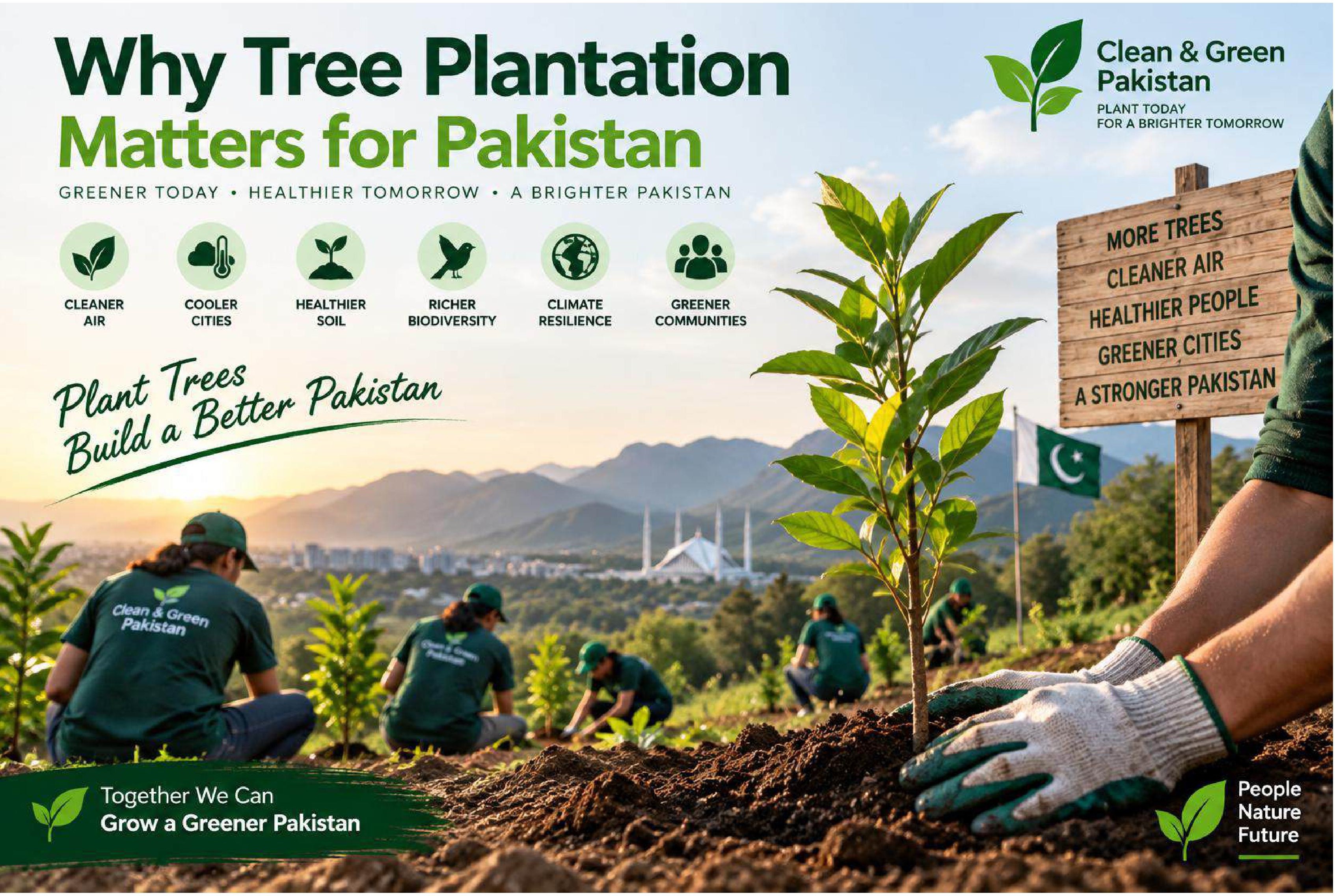
Pakistan is home to diverse landscapes, from the mountains of the north to fertile plains, deserts, river systems and coastal areas. These natural environments support millions of people, wildlife and local economies. However, increasing urbanisation, loss of vegetation, pollution, soil degradation and the impacts of climate change are placing growing pressure on the country's environment.
Tree plantation is one practical way communities can contribute to addressing these challenges. But successful plantation is not simply about putting as many saplings into the ground as possible. It is about planting the right trees in the right places, protecting them and ensuring they survive.
At Clean & Green Pakistan, we believe every successfully established tree is a long-term investment in Pakistan's environmental future.
- Trees Help Improve Air Quality
Air pollution is a serious environmental and public-health challenge in many Pakistani cities.
Trees cannot eliminate air pollution on their own, but they can contribute to healthier urban environments. Leaves can intercept some airborne particles, while trees absorb carbon dioxide during photosynthesis and release oxygen.
Increasing appropriate green spaces around cities, schools, communities, roads and industrial areas can therefore form part of a broader strategy for improving the urban environment.
Planting should complement—not replace—efforts to reduce pollution at its source.
- Trees Help Fight Climate Change
Trees absorb carbon dioxide as they grow and store carbon in their trunks, branches, roots and surrounding soils.
For Pakistan, expanding and protecting healthy tree cover can contribute to climate-change mitigation while providing additional local benefits.
The greatest environmental value comes from trees that survive and mature. This is why plantation campaigns should monitor survival rather than focusing only on how many saplings were initially planted.
- Trees Provide Natural Cooling and Shade
Pakistan experiences extremely hot summers, and heat can be particularly intense in densely developed urban areas.
Trees provide natural shade and can help cool their immediate surroundings through evapotranspiration. Well-designed urban forestry can make streets, parks, schools and community spaces more comfortable.
Large-canopy trees such as Shisham, Siris, Neem and Jamun can provide substantial shade where the species is appropriate for the local climate and site.
- Tree Roots Help Protect Soil
Healthy soil is one of Pakistan's most important natural resources.
Vegetation and tree roots can help stabilise soil and reduce erosion. This can be particularly valuable on appropriate slopes, degraded land and areas affected by wind or water erosion.
Species selection remains critical. Trees planted for soil conservation must match local rainfall, elevation, soil conditions and available water.
- Trees Support Birds, Insects and Wildlife
A tree is more than a source of shade.
It can become a small ecosystem.
Trees can provide nesting sites, shelter, flowers, fruit and other food resources for birds, insects and wildlife. Native and locally appropriate species can be particularly valuable because local wildlife may already depend on them.
Species such as Ber, Jamun, Mulberry and suitable native trees can contribute food as well as habitat.
Planting a diverse mixture of appropriate species is generally more ecologically valuable than relying on one species everywhere.
- Trees Can Help Restore Degraded Landscapes
Some areas of Pakistan suffer from degraded soils, declining vegetation and pressure on natural ecosystems.
Carefully designed plantation and ecological restoration can help re-establish vegetation in suitable locations.
However, restoration is different from simply planting trees.
Natural grasslands, wetlands and other ecosystems should not automatically be converted into forests. Environmental projects need to understand the existing ecosystem before deciding whether trees should be planted and which species belong there.
- Trees Can Provide Economic Benefits
Tree plantation can also create economic opportunities when appropriately planned.
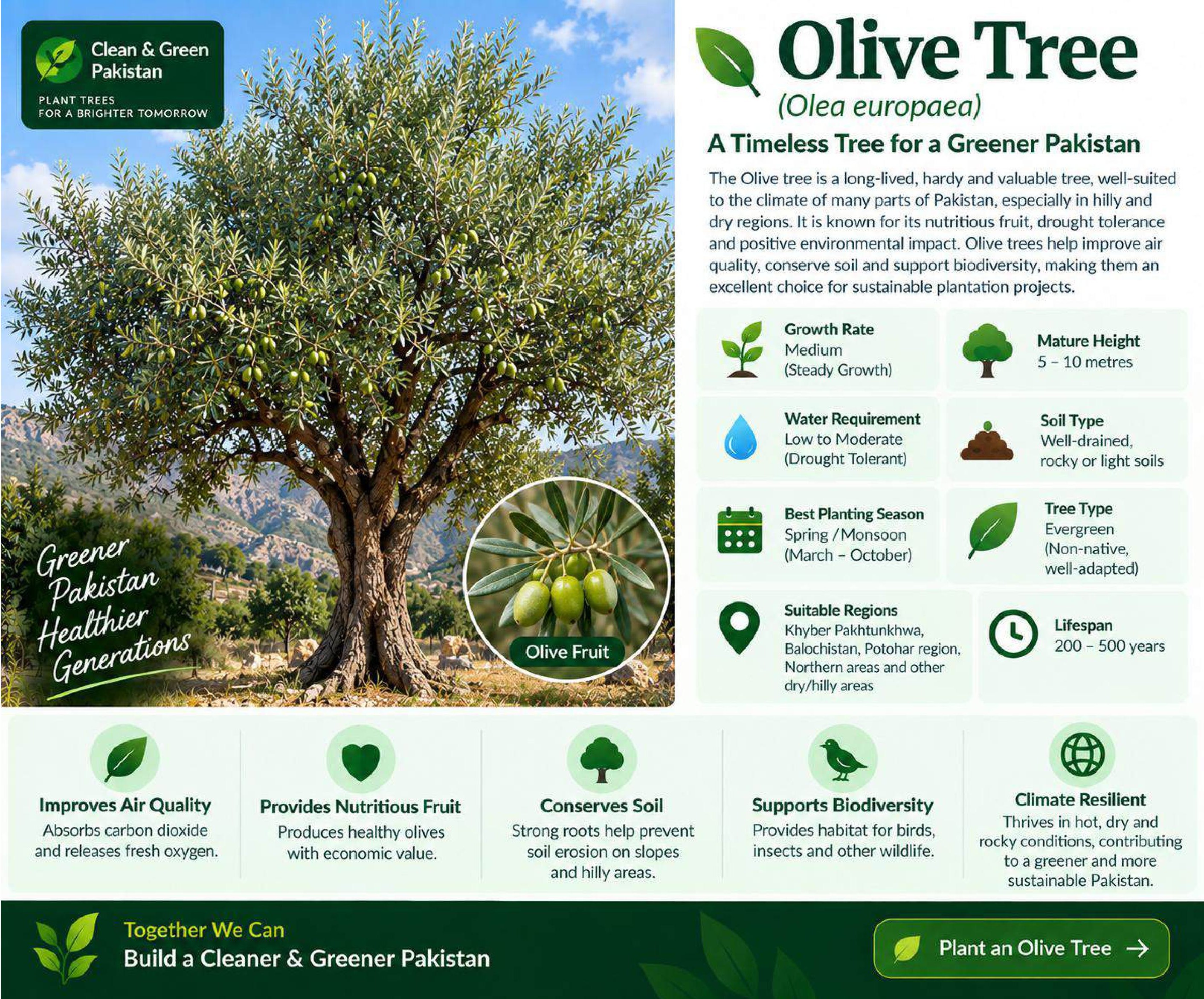
Fruit and productive trees such as Olive, Jamun, Ber and Mulberry can provide environmental benefits while producing useful crops.
Agroforestry—the integration of appropriate trees with agricultural systems—can potentially provide farmers with additional products while maintaining vegetation on agricultural landscapes.
Economic value can also give communities a stronger incentive to protect trees over the long term.
- Trees Make Communities Greener and More Liveable
Parks, streets, educational institutions, hospitals and neighbourhoods benefit from thoughtfully planned green spaces.
Trees can provide shade, improve the appearance of communities and create more pleasant spaces for people to walk, meet and spend time outdoors.
A greener Pakistan therefore does not only mean forests in remote areas.
It also means greener cities, greener villages, greener schools and greener neighbourhoods.
- Native and Locally Suitable Trees Matter
One of the most important principles of responsible plantation is:
Right Tree. Right Place.
Pakistan has dramatically different climatic regions. A species suitable for Sindh may not be appropriate for Abbottabad, while a tree that performs well in the northern mountains may struggle in southern Punjab.
Depending on local environmental conditions, plantation projects may consider species such as:
Shisham Kikar/Babul Siris Neem Jamun Ber Amaltas Mulberry Arjun Pilkhan Phulai Deodar Chir Pine Blue Pine/Kail Olive in suitable growing regions
Species should be selected according to local ecology, altitude, rainfall, temperature, soil, water availability and plantation purpose.
- Planting a Tree Is Only the Beginning
This may be the most important part of any plantation campaign.
Planting a sapling takes minutes.
Growing a healthy tree takes years.
Young trees may require watering, protection from animals, appropriate tree guards, maintenance and replacement if they fail.
A plantation campaign that plants 10,000 trees but loses most of them should not be considered more successful than a smaller project that achieves a high survival rate.
At Clean & Green Pakistan, we want to encourage a different measurement of success:
Don't just count the trees planted. Count the trees that survive.
Our Approach at Clean & Green Pakistan
Our vision is to bring individuals, volunteers, students, communities, educational institutions and organisations together to take practical environmental action.
For responsible plantation projects, we aim to promote a simple approach:
Select → Plant → Protect → Water → Monitor → Report
Before planting, we should ask:
Is the species appropriate for this location?
Is there enough water to establish it?
Who will look after the tree?
How will it be protected?
What percentage survived after one year?
What percentage survived after three years?
Answering these questions can transform tree plantation from a one-day activity into a long-term environmental programme.
How You Can Help
Protecting Pakistan's environment requires participation at every level.
You can contribute by planting an appropriate tree on your property, volunteering in a community plantation, supporting tree maintenance, sponsoring plantation projects, helping monitor existing trees or educating others about responsible environmental practices.
Schools, colleges, universities and businesses can also play an important role by providing volunteers, land, resources and long-term support for environmental projects.
Together, We Can Grow a Greener Pakistan
Pakistan's environmental challenges cannot be solved by tree plantation alone. Protecting existing forests, reducing pollution, conserving water, managing waste responsibly and protecting natural ecosystems are equally important.
But trees remain an important part of the solution.
Every tree that is correctly selected, responsibly planted and successfully protected can contribute to a healthier landscape for decades.
At Clean & Green Pakistan, our goal is not simply to plant more trees.
Our goal is to help create a culture where people plant responsibly, protect what they plant and understand that environmental improvement is a long-term responsibility.
Plant today. Protect tomorrow. Grow a greener Pakistan together.